

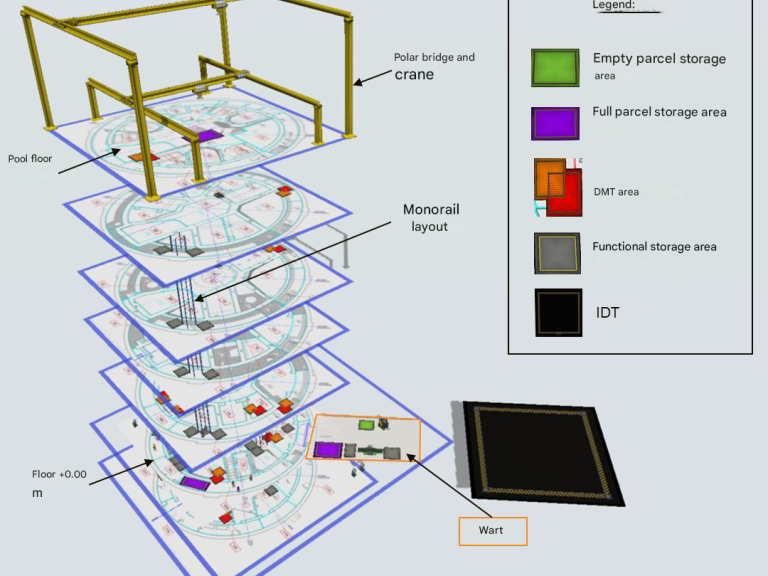
The dismantling of the Fessenheim nuclear power plant is a major industrial challenge. To support EDF in this project, Cyclife Digital Solutions has mobilised its digital expertise to develop an innovative approach and simulate waste flows from activities in Reactor Building No. 2.
Thanks to Cyclife Digital Solutions' dual expertise in IT development and nuclear business expertise, a digital simulator has been developed for the decommissioning of the Fessenheim power plant. It enables waste streams to be highlighted throughout the duration of the project and optimised for an efficient decommissioning schedule.
Why simulate waste streams?
The dismantling of a nuclear reactor generates a significant amount of waste of various types and packaging. The complexity of its disposal is compounded by the specific constraints of a nuclear facility: limited space, multiple co-activities, restricted access, shared resources, containment, etc.
It is easy to imagine that if waste disposal proves difficult, this would have a significant impact on dismantling operations: delays in the intervention schedule, work outages, etc. It is therefore important to consider these issues as early as possible in order to define the dismantling activities. In other words: define the “waste chronicles”.
Stream simulation generally enables to:
- Validate the waste production timeline;
- Analyse intermediate and temporary storage capacities;
- Identify potential bottlenecks;
- Test several scenarios for human and material organisation;
- Support technical and strategic decisions with reliable indicators.
Focus on waste streams from Fessenheim
The main objective of the study was to develop a waste stream simulation model, using FlexSim software, for the removal of waste produced by the dismantling operations on each floor of Reactor Building No. 2 (BR2) at Fessenheim.
Nicolas de Bièvre, Design Engineer at Cyclife Digital Solutions, explains:
"A stream simulation model is an effective solution that allows different pathways generated by dismantling activities to be simulated and the strategy and capacity for waste disposal to a final storage site or to intermediate and temporary storage sites to be studied. The simulation model created takes into account the full complexity of interactions between human resources, evacuation routes, handling equipment, storage areas, waste packages and the local environment."
Output indicators and measurement tools
Cyclife Digital Solutions' expertise enables detailed forecasting of bottlenecks, regardless of their origin, such as incorrect assessment of a workstation's pace, machine breakdowns, maintenance issues, etc.
The output indicators and measurement tools (graphs, tables, etc.) were defined in collaboration with the project managers.
The main indicators for this project are as follows:
- Job occupancy rate
- Handling equipment utilisation rate
- Number of shuttle crates used/produced over time
- Warehouse/storage area occupancy rate
- Number of parcels shipped per week

Tangible results for the project
The timeline for waste generated by dismantling activities has been validated for the entire duration of the project:
- A single saturation point has been identified (third quarter of 2032), which has been resolved by a simple adjustment to the schedule
- The volumes to be processed have been consolidated: more than 2,900 packages modelled
- Human resource requirements have been clarified (profiles, staffing levels, organisation)
- Risks have been better anticipated, thanks to proposals for technical and organisational adjustments

Concrete benefits for EDF
EDF DP2D (Waste Management and Decommissioning Department) is very satisfied with the stream model provided and is already using it to simulate different scenarios in order to prepare for this major decommissioning project.
The stream studies carried out on behalf of EDF in recent years have brought many benefits in terms of:
- Complete visibility of reactor building activities in real time;
- Ability to choose between several strategies based on objective performance indicators;
- HR sizing support tool (profiles, workloads, schedules);
- Anticipation of contingencies and continuous adaptation of the project;
- Capitalisation of data throughout the project lifecycle.