
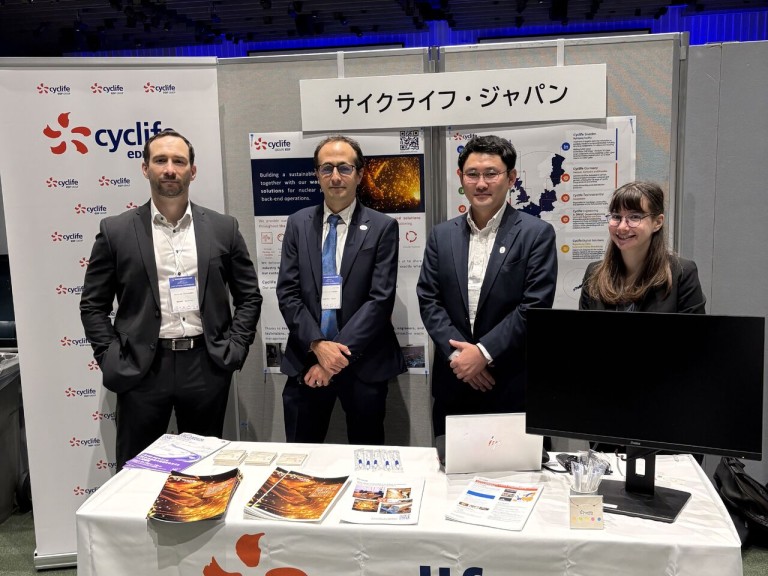
Cyclife Japan is turning two. Established in February 2024, our Tokyo-based subsidiary is becoming a key asset in Cyclife Group’s international growth strategy. Positioned in one of the world’s most strategic nuclear markets, Cyclife Japan brings our proven expertise in dismantling, waste management, and digital solutions to support Japan’s energy transition and future nuclear lifecycle.
A High-Potential, Highly Complex Decommissioning and Dismantling Market
Japan represents one of the largest and strategically most significant decommissioning and dismantling (D&D) markets worldwide in the decades to come.
Of the approximately 60 reactors, 14 have been restarted and 24 are officially in the process of being decommissioned, including all of the units at the Fukushima Daiichi power plant and a mix of PWR, BWR, graphite, HWR and FBR designs. While these projects are critical for the country, they evolve in a challenging environment: there is still no designated permanent repository, delaying dismantling projects; no treatment facilities are currently operating; and public acceptance of the 'free release' of materials remains low.
Cyclife Japan was established on 1 February 2024 to address these challenges, building on activities initiated by EDF Deconstruction and Waste Direction (D2PD) since 2020 and supported by the global expertise of the Cyclife Group.
There are opportunities in the field of nuclear decommissioning and waste management. Offshore treatment regulations have been evolving for a few years, allowing the shipment of steam generators, heat exchangers, and casks outside Japan for treatment under strict export conditions, while awaiting the construction of future metal treatment facilities (MTFs), which are not expected before 2035 - projects under investigation by TEPCO in Fukui-. The market is substantial, with over 100 steam generators and large BWR components, as well as dismantling waste.
Cyclife Japan: Mission and Strategic Role
Cyclife Japan, based in Tokyo, is an agile subsidiary created to bring Cyclife Group's proven expertise in dismantling, radioactive waste treatment and digital solutions to one of the world's most complex nuclear markets.
Having a local presence is essential for navigating a fragmented, highly regulated environment and building strong partnerships with Japanese industry leaders.
Patrick Dupeyrat, Managing Director of Cyclife Japan comments:
"Cyclife Japan is a key pillar of the international growth of the Cyclife Group. We aim to combine global expertise with local partnerships to support Japan’s nuclear lifecycle and energy transition in a sustainable and responsible way."
By leveraging the capabilities of Cyclife’s facilities in France, Sweden and the UK, the teams at Cyclife aim to deliver practical solutions, such as exporting large components for treatment in Europe.
At the same time, Cyclife Japan's teams are preparing for future domestic facilities through technology-sharing partnerships. Japan’s dismantling programme will generate unprecedented volumes of metallic waste, and Cyclife Japan is committed to ensuring the safe, efficient and sustainable management of these materials.
Japan: A Strategic Country for EDF
Japan is the world’s fourth-largest economy and a technologically advanced nation that plays a major role in civil nuclear energy. In the context of a global energy crisis and the urgent need for decarbonisation and secure electricity production, Japan's position is stronger than ever. Nuclear power has been reaffirmed as a short-term necessity, driving an ambitious 2040 strategy: a 20% nuclear energy mix.
This strategy is based on three pillars:
- Restarting reactors that were suspended after Fukushima,
- Extending the operational life of existing units and,
- Accelerating the dismantling of ageing assets and waste management to prepare for new builds
EDF has long supported this approach through its representative office and several subsidiaries in Japan, including EDF Trading, EDF Power Solutions and Framatome, as well as Cyclife Japan, which was established to address dismantling and waste management challenges.