

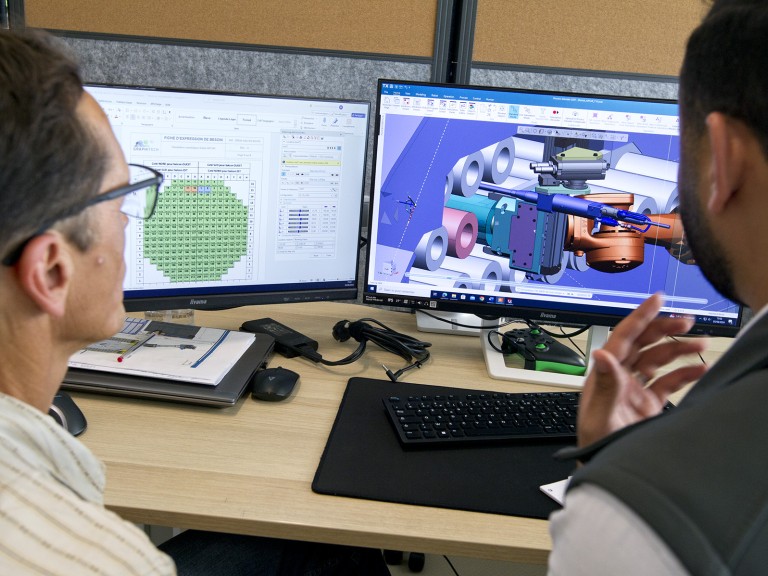
Like the stone that held Excalibur—the sword from Arthurian legend reputed to be impossible to pull from the ground—the Brennilis reactor, also situated in the mountains of Brittany, could well have earned a reputation as a reactor that could never be dismantled. But that was without counting on the expertise and innovation of the teams at Graphitech, a subsidiary of EDF and Veolia specialising in complex decommissioning projects. Graphitech is currently developing the robot that will extract the 216 “Excaliburs” from the Breton power station. Its name is… ARTUR.
Through engineering work in Lyon and testing at EDF’s Industrial Demonstrator, Graphitech’s teams are tackling a major technological challenge by designing a robotic system specifically for removing the pressure tubes from the Brennilis reactor vessel during the fourth phase of the EL4 reactor’s decommissioning, scheduled to take place by 2030. The robot is called ARTUR: Advanced Robot for TUbes Removal.
Permanently shut down 40 years ago, the Brennilis nuclear power station is now part of the development portfolio of Graphitech, the joint subsidiary of EDF and Veolia. Indeed, Brennilis represents a unique decommissioning project due to its technology: its reactor is the only example of the ‘heavy water’ type in France.
Located east of Brest in Finistère, the power station remained in operation for nearly 18 years, generating enough electricity to power a town of 385,000 inhabitants. It was finally decommissioned in 1985 in favour of a more competitive technology: the pressurised water reactor.
Following the issuance of the decree in September 2023, decommissioning work officially began in December 2025 once the decree came into force. The first phase of the project will aim to clear space to allow robots to operate within the reactor vessel, the most sensitive part of this unique decommissioning process.
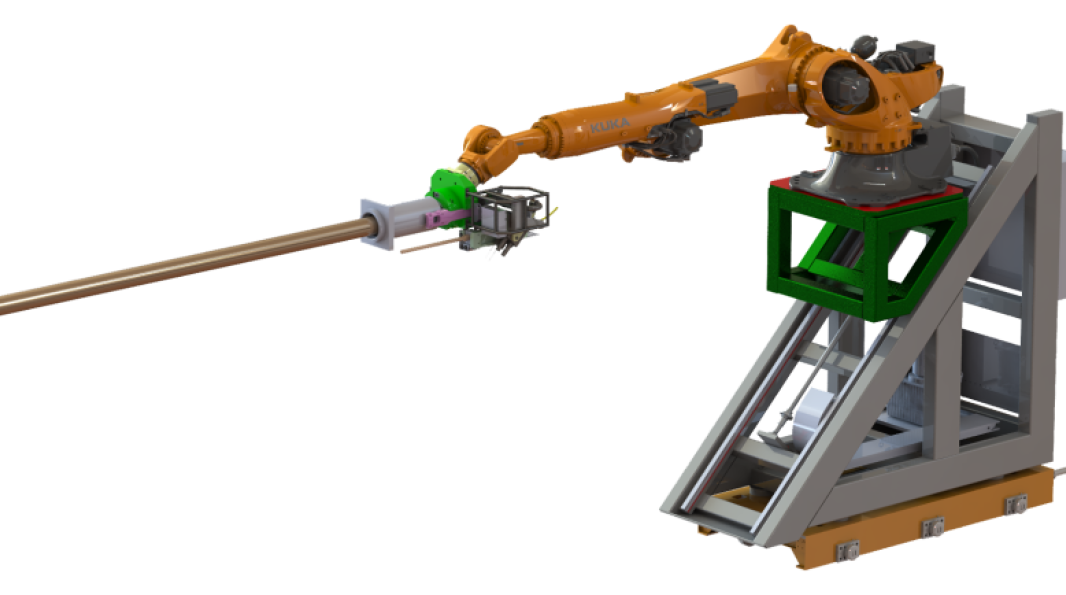
3D rendering of the "ARTUR" robotic arm
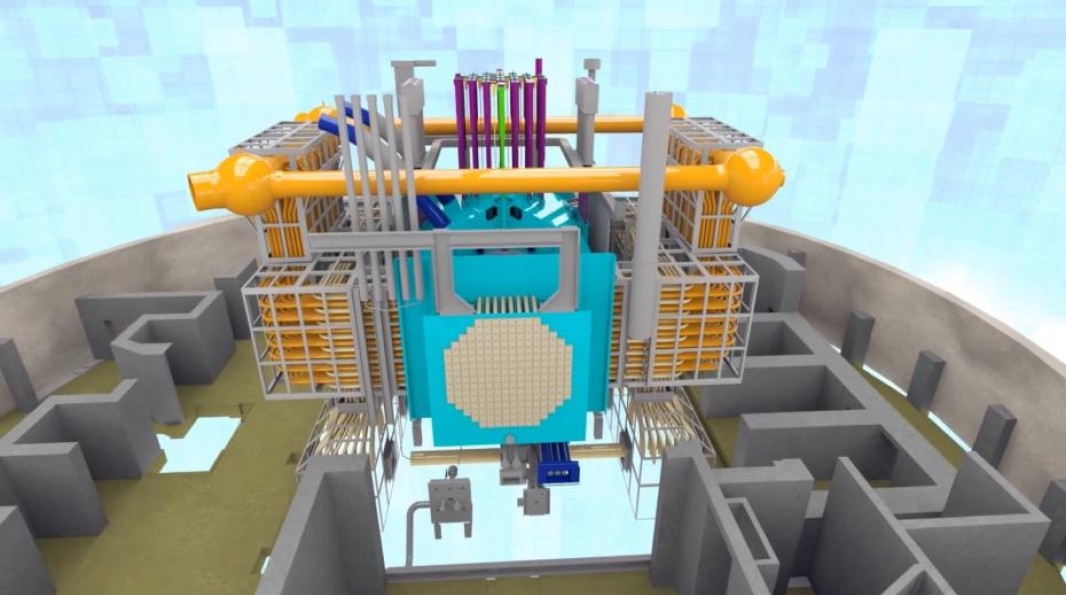
The heavy-water reactor at EDF’s nuclear power station in Brennilis, one of the most complex to decommission
Start of the design phase
It is through this complex challenge that Graphitech is participating in the operations alongside EDF DP2D (Department for Decommissioning and Waste Management Projects), to design a system capable of operating in a sensitive area and forcibly extracting the tubes from the Brennilis reactor vessel. Named ARTUR, after the king from Breton legend who pulled the sword from the stone, the robot developed by Graphitech will carry out these tube extractions during the fourth phase of the EL4 reactor decommissioning, scheduled for 2030. ARTUR follows on from the Fetch project, carried out jointly by EDF DP2D, IRT Jules Verne and Graphitech, which aimed to initiate the design of the architecture for a semi-autonomous robot for the dismantling of pressure tubes.
In the case of Brennilis, the ARTUR robotic system will be tasked with removing the 216 cross-tubes located in the reactor vessel, which were used to hold the fuel. It will coordinate a laser cutting tool and a gripper to carry out the removal on a case-by-case basis, thereby reducing the risk of errors.
ARTUR is semi-autonomous, enabling semi-automated operation whilst maintaining a certain level of precision thanks to cameras designed to verify position and validate the stages of the operation. Using a “carrier”, the robot can then extract these detached tubes and place them for transport to a storage area.
Laurent Cluzel, technical pilot on this project, explains the importance of Graphitech's skills in the industrial development of this robot.
"Graphitech’s major contribution was to propose a two-stage solution for cutting the tank bottoms. First, the initial sides of the reactor block are cut using the robotic arm’s movements; the tube is then held in place by the robot before the final side is cut by another movement."
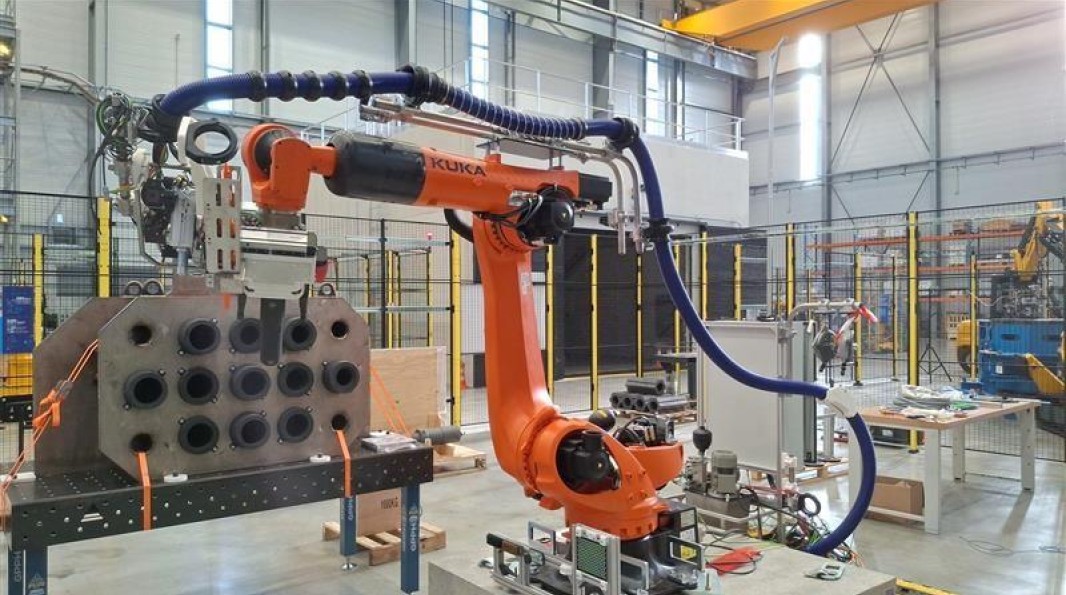
ARTUR begins testing at EDF’s Industrial Demonstrator near Chinon
A major technical challenge
One of the major constraints of the project, that Graphitech had to contend with, was the limited space on either side of the reactor vessel. Indeed, the space between the reactor block and the containment walls is 140 cm wide, whilst the pressure tubes, once split in two, are each 160.5 cm long per section. Graphitech’s engineering team therefore had to overcome a real technical challenge to carry out these operations safely in such a confined space.
"Our job involves taking into account the site conditions as they stand at the start of the relevant dismantling phase. We then use computer simulation to verify that the robot’s movements allow it to follow the correct trajectories. The main constraint is the space available for removing these pipes; another key factor is the precision of the laser cutting." comments Laurent Cluzel, technical pilot on this project at Graphitech.
Laser cutting is precisely a skill that Graphitech began to develop in 2024 at EDF’s Industrial Demonstrator near Chinon, and which is now being put to use in the Brennilis decommissioning project.
The laser unit had to be adapted to meet a specific challenge: cutting the stainless steel contained within the reactor block, which required the cutting tool to be adapted to the specific passage available at Brennilis: just 30 millimetres wide.
"For cutting, the laser’s focal point must therefore be focused as close as possible to the surface, and Graphitech had to develop a bespoke tool to carry out this operation. We chose to develop, in collaboration with a partner, a highly specialised laser cutting head because, to date, no system was capable of doing so." comments Laurent Cluzel.
Start of the test campaign
It is within this framework that an innovative cutting head has been developed, enabling access to the bottom of the tank that holds the tubes. This head was designed using tests on a realistic physical model that replicates the dimensional constraints of the passage. All of this is taking place within the innovation hub created by EDF: the Industrial Demonstrator.
The first physical tests will take place in early 2026. They will, in particular, verify the cutting, trajectory and gripping functions once the integration phase is complete.
A second round of tests will subsequently help to put the procedure into practice, validate the documentation and train the teams. This phase is essential for fully understanding the sequence of operations, thereby avoiding malfunctions and potential risks.
"As for risk mitigation, following the numerical simulations, physical tests will be carried out in early 2026 using scale models, enabling the feasibility to be definitively validated." underlines Laurent Cluzel, technical pilot at Graphitech
The deployment of the ARTUR robot is scheduled for 2030 and is expected to take five months, including installation and dismantling. These few months will mark the culmination of many years of development at Graphitech to find the best, most efficient and safest solution. This is a real technical challenge, both because of the complexity of the Brennilis reactor vessel layout and the technical solutions required to bring the project to fruition.
Located east of Brest in Finistère, the Brennilis nuclear power station remained in operation for nearly 18 years, generating enough electricity to power a town of 385,000 people. It was finally shut down in 1985.
